
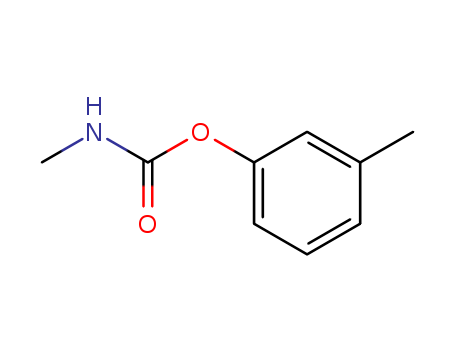
METOLCARB
- CasNo:1129-41-5
Product Description
Factory Export Top Purity METOLCARB 1129-41-5 In Stock
- Molecular Formula: C9H11NO2
- Molecular Weight: 165.192
- Appearance/Colour: yellow liquid
- Vapor Pressure: 0.000358mmHg at 25°C
- Melting Point: 74-77 °C
- Refractive Index: 1.5270 (estimate)
- Boiling Point: 241.6 °C at 760 mmHg
- PKA: 12.38±0.46(Predicted)
- Flash Point: 99.9 °C
- PSA: 38.33000
- Density: 1.085 g/cm3
- LogP: 2.10410
METOLCARB(Cas 1129-41-5) Usage
|
Preparation |
Metolcarb is produced by the reaction between 3- methylphenol and Metolcarb. |
|
Air & Water Reactions |
Soluble in water. |
|
Reactivity Profile |
METOLCARB is a carbamate ester. Carbamates are chemically similar to, but more reactive than amides. Like amides they form polymers such as polyurethane resins. Carbamates are incompatible with strong acids and bases, and especially incompatible with strong reducing agents such as hydrides. Flammable gaseous hydrogen is produced by the combination of active metals or nitrides with carbamates. Strongly oxidizing acids, peroxides, and hydroperoxides are incompatible with carbamates. |
|
Health Hazard |
High oral and skin toxicity, and moderate inhalation toxicity. (Non-Specific -- Carbamates) Some carbamates appear to be carcinogenic, teratogenic, and/or mutagenic. Carbamates are cholinesterase inhibitors. |
|
Fire Hazard |
As for other solid carbamate pesticides, container may explode in heat of fire. Fire and runoff from fire control water may produce irritating or poisonous gases. Emits toxic fumes of nitrogen oxides when heated to decomposition. Avoid decomposing heat. |
|
Trade name |
DRC 3341?; KUMIAI?; METACRATE?; S 1065?; SOGATOX DUST? 22; TSUMACIDE?; TSUMAUNKA?; VADEN? |
|
Safety Profile |
Poison by ingestion and skin contact. Moderately toxic by inhalation. Mutation data reported. When heated to decomposition it emits toxic fumes of NOx. See also CARBAMATES. |
|
Potential Exposure |
Metolcarb is an insecticide used for the control of rice leafhoppers, plant-hoppers; codling moth; citrus mealy bug; onion thrips; fruit flies; bollworms and aphids. Not registered as a pesticide in the United States. |
|
Metabolic pathway |
The main pathways of metabolism of metolcarb in plants, mammals and insects involve ring-methyl, N-methyl and phenyl-ring hydroxylation and conjugation. Carbamate ester hydrolysis is a minor reaction. Further oxidation of a ring-hydroxymethyl moiety to carboxyl occurs in rats and insects. |
|
Shipping |
UN2757 Carbamate pesticides, solid, toxic, Hazard Class: 6.1; Labels: 6.1-Poisonous materials. UN3077 Environmentally hazardous substances, solid, n.o.s., Hazard class: 9; Labels: 9-Miscellaneous hazardous material, Technical Name Required. |
|
Incompatibilities |
Carbamates are incompatible with reducing agents such as hydrides, strong acids, oxidizing acids, peroxides, and bases. Contact with active metals or nitrides cause the release of flammable, and potentially explosive, hydrogen gas. May react violently with bromine, ketones. Incompatible with azo dyes, caustics, ammonia, amines, boranes, hydrazines, strong oxidizers. |
|
Waste Disposal |
Consult with environmental regulatory agencies for guidance on acceptable disposal practices. Generators of waste containing this contaminant (≥100 kg/mo) must conform to EPA regulations governing storage, transportation, treatment, and waste disposal. In accordance with 40CFR165, follow recommendations for the disposal of pesticides and pesticide containers. Must be disposed properly by following package label directions or by contacting your local or federal environmental control agency, or by contacting your regional EPA office. |
|
General Description |
Colorless crystalline solid. METOLCARB is an insecticide for the control of rice leafhoppers, planthoppers, codling moth, citrus mealybug, onion thrips, fruit flies, bollworms and aphids. Not registered as a pesticide in the U.S. |
|
Agricultural Uses |
Insecticide, Acaricide: Metolcarb is an insecticide for the control of rice green leafhoppers, plant-hoppers, codling moth, citrus mealy bug, onion thrips, fruit flies, bollworms and aphids. Not registered for use in the U.S. Not listed for use in EU countries. |
InChI:InChI=1/C9H11NO2/c1-7-4-3-5-8(6-7)10(2)9(11)12/h3-6H,1-2H3,(H,11,12)/p-1
1129-41-5 Relevant articles
Fluid insecticidal formulations for treatment of parasitic insect larvae by dermal application
-
, (2008/06/13)
The present invention relates to the use...
Pesticidal composition containing a microencapsulated organo-phosphorus or carbamate in a pyrethroid dispersion
-
, (2008/06/13)
An insecticidal and/or acaricidal and/or...
α-Haloalkyl Haloformates and Related Compounds 1. A Convenient Synthesis of Carbamates via Chloromethyl Carbamates
Patonay, Tamas,Patonay-Peli, Erzsebet,Mogyorodi, Ferenc
, p. 2865 - 2885 (2007/10/02)
The preparation of carbamates under mild...
Pyrazole oxime derivatives and compositions
-
, (2008/06/13)
A pyrazole oxime derivative represented ...
1129-41-5 Process route
-

-
75-44-5
phosgene

-

-
108-39-4
3-methyl-phenol

-
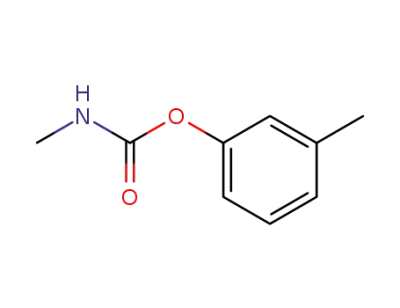
-
1129-41-5
metolcarb
| Conditions | Yield |
|---|---|
|
With
methylamine;
In
toluene;
|
78%
|
-
-
108-39-4
3-methyl-phenol
-
-
1129-41-5
metolcarb
| Conditions | Yield |
|---|---|
|
Multi-step reaction
with
2
steps
1: 79.3 percent / Et3
N / CH2
Cl2
/ 1.67 h / 5 °C
2: 54 percent / H2
O; hexane / 2 h / Ambient temperature
With
triethylamine;
In
hexane; dichloromethane; water;
|
|
|
In
Isopropylbenzene;
|
1129-41-5 Upstream products
-
108-39-4
3-methyl-phenol
-
624-83-9
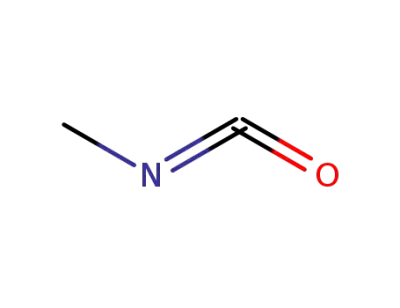
methyl isocyanate
-
132905-78-3

Carbonic acid chloromethyl ester m-tolyl ester
-
74-89-5
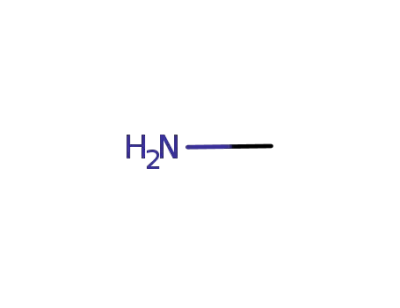
methylamine
1129-41-5 Downstream products
-
39074-23-2
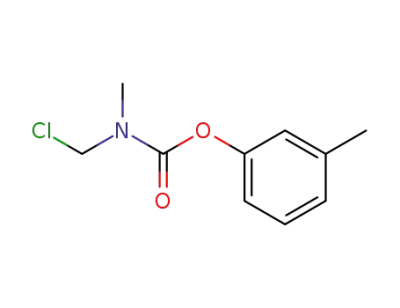
Chloromethyl-methyl-carbamic acid m-tolyl ester